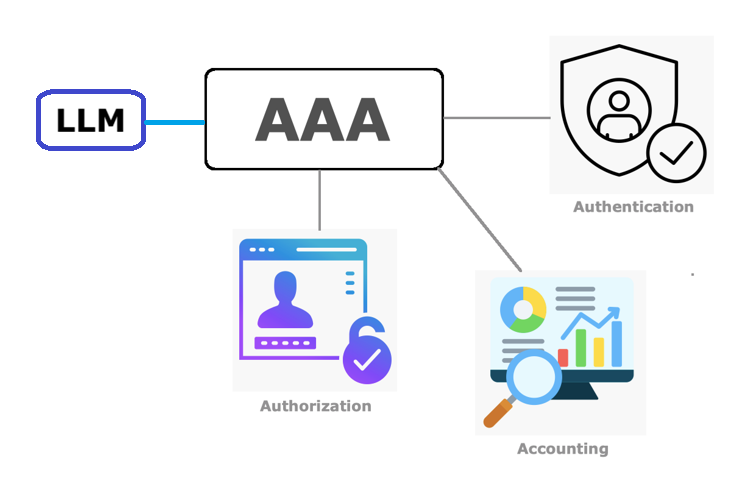
AAA Server

What is AAA Server with LLM?

AAA (Authentication, Authorization, and Accounting) server providing a centralized system for managing access, privileges, and usage tracking for users and devices across a network. A AAA server is a critical component in network security used in various network environments, including wired and wireless, and they play a key role in safeguarding resources and ensuring compliance with access policies.

The LLM (Large Language Model) solution for AAA-BRAS enhances traditional Authentication, Authorization, and Accounting systems by introducing AI-driven intelligence to analyze logs, policies, and usage data in natural language.

It enables automated troubleshooting, intelligent insights, and user-friendly explanations for administrators, support teams, and subscribers.

By integrating with existing AAA and BRAS platforms, the solution transforms complex technical data into actionable, explainable, and auditable information, improving operational efficiency, service reliability, and customer experience.

AAA (Authentication, Authorization, and Accounting) Server

Authentication:

  • Purpose: Verifies the identity of users or devices attempting to connect to the network.
  • Protocols Used: Common protocols include RADIUS (Remote Authentication Dial-In User Service) and TACACS+ (Terminal Access Controller Access-Control System Plus), which handle encrypted communication between the server and client.

Authorization:

  • Purpose: Grants or denies access to specific resources or services based on user identity and predefined policies.
  • otocols Used: RADIUS and TACACS+ are also used here to specify policies, often integrating with LDAP (Lightweight Directory Access Protocol) or Active Directory for user role management.

Accounting:

  • Purpose: Tracks user activity, resource consumption, and session data for auditing, monitoring, and billing purposes.
  • How It Works: The AAA server logs various metrics, such as login times, duration of access, bandwidth usage, and actions taken within the network.


  • Policy Management and Enforcement: Allows for granular control over which resources and services users and devices can access, enabling policies that consider user roles, time-of-day, device type, or network location.

  • Multi-Factor Authentication (MFA): Provides an added layer of security by requiring users to verify their identity through multiple methods, such as a password and a one-time code sent to their phone.

  • Integration with Directory Services: AAA servers can integrate with LDAP, Active Directory, and other directory services for streamlined user management and single sign-on capabilities.

  • Encryption and Secure Communication: Ensures that authentication data and user credentials are encrypted and transmitted securely.

  • Failover and Redundancy: Many AAA servers support high availability setups with failover capabilities to maintain network access and security in case of server failure.

  • Compatibility with Multiple Network Types: Supports wired and wireless, making the AAA server versatile for enterprise environments.


1. Centralized Access Control: -

  • By having a single, centralized system for managing access, a AAA server simplifies network management and ensures consistent security policies across different network types and devices.

2. Enhanced Security: -

  • AAA servers enforce authentication and authorization rules, limiting access to trusted users and devices only, and reducing the risk of unauthorized access.

3. Detailed Audit and Compliance: -

  • With accounting features, AAA servers enable comprehensive logging and reporting, which is essential for regulatory compliance and for investigating security incidents.

4. Scalability: -

  • AAA servers are designed to handle thousands of concurrent users and devices, making them suitable for large organizations with high user density.

5. Improved User Experience: -

  • Features like single sign-on (SSO) allow users to authenticate once and gain access to multiple services without multiple logins, improving efficiency.

6. Billing and Resource Management: -

  • By tracking resource usage and session data, organizations can charge users based on consumption, allocate resources more effectively, and plan for capacity needs.


  • Authentication: Verifying the identity of users or devices attempting to access the network. Supports user/device authentication using protocols such as RADIUS (Remote Authentication Dial-In User Service) and TACACS+ (Terminal Access Controller Access-Control System Plus). Authentication methods include user credentials, certificates, and hardware tokens.

  • Authorization: Controls access to specific network resources based on predefined user roles and policies.

  • Accounting: Logs and monitors user activity, session durations, data usage, and connection times for audit, billing and reporting purposes.


  • Authentication: Typically supports authentication for devices connecting to Wi-Fi, using protocols like EAP (Extensible Authentication Protocol) variants over RADIUS, WPA2-Enterprise, and WPA3.

  • Authorization: Allows or restricts network access based on user roles, locations, and device type, integrating with access points and wireless controllers.

  • Accounting: Tracks wireless session data, bandwidth consumption, and duration for managing network load and billing.


1. LLM-Powered Network Support (Tier-1 / Tier-2): -

Problem: -
NOC and support teams spend time Reading RADIUS / BRAS logs, Understanding authentication failures and Answering repetitive subscriber issues

LLM Solution: -
An internal chat assistant trained on AAA logs (RADIUS, TACACS+, Diameter), BRAS error codes and troubleshooting guides

Example use: -
Support Engineer : Why is subscriber user123@isp unable to authenticate?
Authentication failed due to Access-Reject (RADIUS Code 3)

Reason: Password expired (Reply-Message: E=691)
Suggested actions: -
1. Reset password in AAA system
2. Verify NAS-IP-Address = 10.10.5.1 matches policy
3. Retry PPPoE session


2. AAA Log Intelligence & Root Cause Analysis: -

Problem: -
Raw AAA logs are noisy and hard to interpret Millions of records/day and Hard to identify abnormal behavior

LLM Solution: -
LLM summarizes, explains, and correlates logs.

Example use: -
Input (Logs):
Access-Request
User-Name=user456@isp
NAS-IP-Address=172.16.1.10

LLM Output: -
This failure is likely caused by: -
- Incorrect password OR
- User bound to different BRAS profile
Correlation:
- Same user had 5 failed attempts in last 10 minutes
- Possible credential misuse or device misconfiguration


3. Self-Service Subscriber Chatbot (Customer-Facing): -

Problem: -
Subscribers ask repetitive questions: -
- “Why is my internet slow?”
- “Why was I disconnected?”
- “How much data left?”

LLM Solution: -
A safe, controlled chatbot that: -
- Reads accounting data
- Explains issues in plain language
- Does NOT expose sensitive internals

Example use: -
Subscriber: Why did my connection drop?
LLM Output: -
Your session ended because your monthly data quota was fully used.
You can purchase a top-up or wait for next billing cycle.


4. AAA Compliance & Audit Reporting (AI-generated): -

Problem: -
Compliance (ISO, MCMC, internal audit) is manual.

LLM Solution: -
Generate audit-ready reports from logs.

Example use: -
AAA Access Audit - January 2026
- Total authentications: 12.4M
- Failed logins: 2.1%
- Suspicious activities flagged: 312
- Corrective actions taken: 287


5. Knowledge Base (RAG): -

Problem: -
Knowledge scattered across different PDFs and Wiki pages.

LLM Solution: -
Central Ask-Your-AAA-System knowledge base.

Example use: -
What does RADIUS code 65 mean on H3C BRAS?

LLM Answer (with source): -
RADIUS Code 65 = User quota exceeded
Source: H3C BRAS AAA Guide v8.2


In summary, AAA servers provide critical security, control, and insight into network usage, making them indispensable for managing secure network access. Their features not only support a secure environment but also allow organizations to maintain compliance, monitor usage, and optimize resource allocation.

© Copyright 2026 Sysvolution Sdn. Bhd. All Rights Reserved.